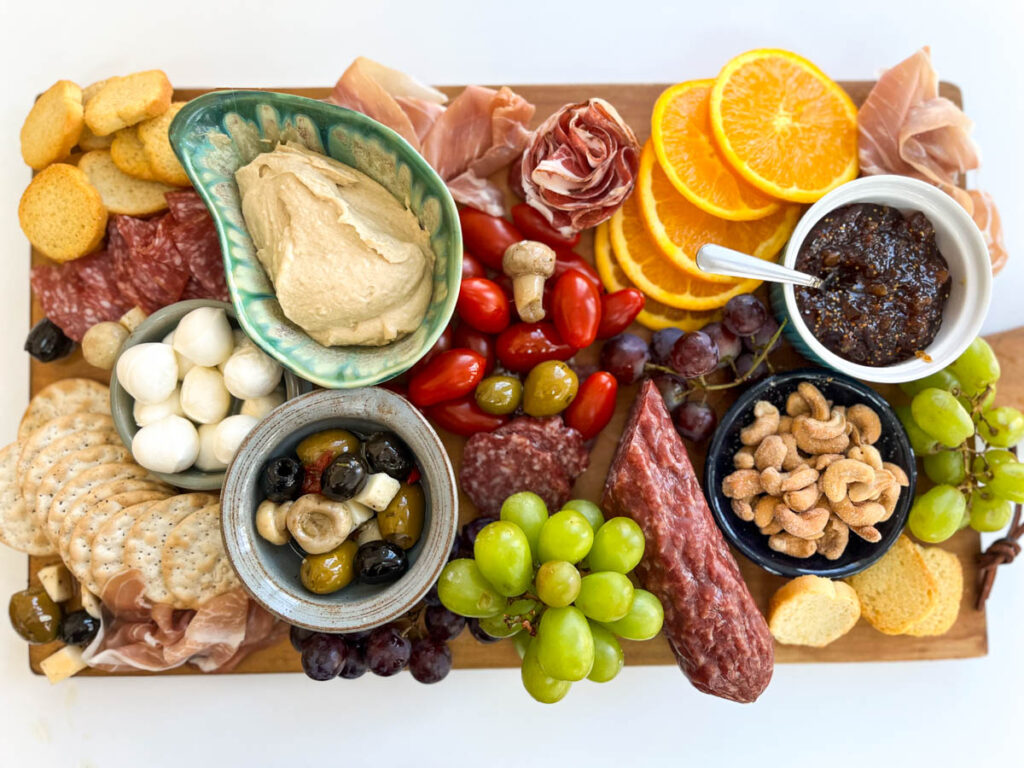
The honest answer is two hours. That’s the window the USDA sets for perishable foods at room temperature, and a charcuterie board, built almost entirely from meat, cheese, and dairy, falls squarely within that guideline. Knowing how long you can let a charcuterie board sit out is the difference between a great party and a complete mess!
But two hours is a ceiling, not a target. Here’s what you actually need to know to serve safely and confidently.
The Two-Hour Rule, Explained
Bacteria multiply rapidly between 40°F and 140°F — what food safety guidelines call the “danger zone.” At room temperature, most charcuterie ingredients sit right in the middle of that range. After two hours, bacterial growth reaches levels that can cause foodborne illness, even if the board looks and smells fine.
If your kitchen or party space is particularly warm, above 90°F, that window shrinks to one hour. Outdoor summer gatherings, in particular, deserve extra attention.
Which Ingredients Are Most at Risk?
Not everything on a board ages at the same rate.
Soft cheeses — brie, camembert, goat cheese, fresh mozzarellam are the most vulnerable. Their high moisture content accelerates bacterial growth. These should come off the board first if you’re approaching the two-hour mark.
Hard and aged cheeses — parmesan, aged cheddar, manchego — are more forgiving. Low moisture and higher salt content give them some natural resistance, but they’re not immune.
Cured meats — prosciutto, salami, soppressata, are salt-preserved and have longer safe windows than fresh proteins, but they’re not shelf-stable once sliced and plated. Treat them the same as everything else.
Fresh additions — sliced fruit, soft dips, anything with fresh herbs or cream, are your most time-sensitive items. If you’re building a board well in advance, add these last, as close to serving as possible.
How to Extend Your Board Safely
Two hours is workable for most gatherings, but there are ways to protect the food and extend your margin.
Build in stages. Don’t put everything out at once. Keep a backup plate of cheese and meat in the refrigerator and swap it onto the board halfway through the party. Your guests get fresher food; you get more time. (see how far ahead to make a board)
Chill the board itself. Marble and slate boards retain cold well. Run yours under cold water before building, or set it over a tray of ice during the event. This won’t transform the safety window dramatically, but it slows the temperature rise of the food sitting on it.
Work with smaller portions. A smaller board replenished twice looks more abundant, and more intentional, than a large board left to deplete. It also means less food spends time in the danger zone.
Serve in a cool room. Air conditioning makes a real difference. A 68°F room gives you meaningfully more runway than an 80°F one.
Can You Refrigerate and Reuse a Board?
If your board has been out for less than two hours, yes, wrap it tightly and refrigerate promptly. It’s safe to serve again within three to four days, though the quality of soft cheeses and cut fruit will decline quickly.
If the board has been out for more than two hours, the conservative and correct answer is to discard the perishables. It’s not worth the risk.

Three Mistakes That Shorten Your Window
Building the board hours before guests arrive. Prep your components in advance, but assemble as close to serving time as possible. A board that’s been sitting at room temperature for 90 minutes before the party starts has almost no remaining margin.
Leaving soft cheeses out too long. Brie that’s been sitting for three hours isn’t just a safety risk — it’s lost its texture and appeal. Pull soft cheeses earlier; let harder cheeses linger a little longer.
Forgetting about warm rooms. Most people mentally clock the two-hour rule but forget to adjust for heat. Check the temperature of your space before you serve.
The Practical Takeaway
Two hours at room temperature. One hour in the heat. Build in stages if you’re hosting a long event. When in doubt, refrigerate promptly or discard.
A board built with this awareness doesn’t just protect your guests — it tastes better, because the food is fresher when it hits the table.