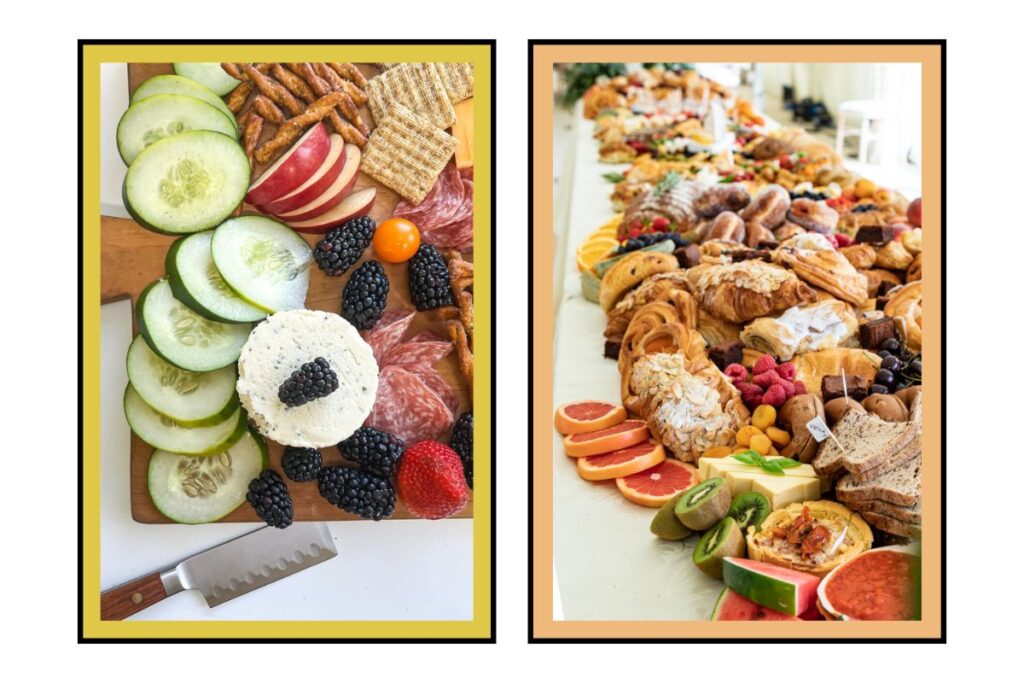
If you’ve been looking at ideas for making a charcuterie board, you’ve likely come across grazing tables (or grazing boards). You may be wondering what the actual difference is between in a grazing table vs. charcuterie board. The quick answer: a charcuterie board is a single platter meant to serve a handful of people, while a grazing table is a much larger spread, often set up directly on a table, designed to feed a crowd. Grazing tables are essentially charcuterie boards scaled way up, with more variety, more stations, and more real estate.
Below I’ll break down the differences so you can figure out which one actually fits your event. If you want ideas for building a charcuterie board you can find 100 Amazing Charcuterie Board Ideas to get you started.
Hi, I’m Gretchen - creator of Amazing Charcuterie Boards. I help home hosts and beginners create beautiful, stress-free charcuterie boards with simple rules, realistic portions, and easy styling techniques.

If you’re planning your next board, you may also find these helpful:
→ Charcuterie Board Portion Calculator
→ How to Design a Charcuterie Board (simple rules & layouts)
→ The Best Charcuterie Board Pairings

Want more board ideas and planning guides? Join my free newsletter here or search ideas.
Grazing Table vs Charcuterie Board: The Quick Comparison
| Charcuterie Board | Grazing Table | |
|---|---|---|
| Serves | 2–15 people | 20–100+ people |
| Surface | A single board or platter | A full table (or several tables pushed together) |
| Setup time | 10–30 minutes | 1–3 hours |
| Cost | $20–$200 | $300–$1,000+ |
| Best for | Dinner parties, date night, small gatherings | Weddings, corporate events, large parties |
| Portability | Easy to make ahead and carry | Usually assembled on-site |
If you’re trying to decide which one you actually need, the size of your guest list is really the deciding factor.
What Is a Charcuterie Board?
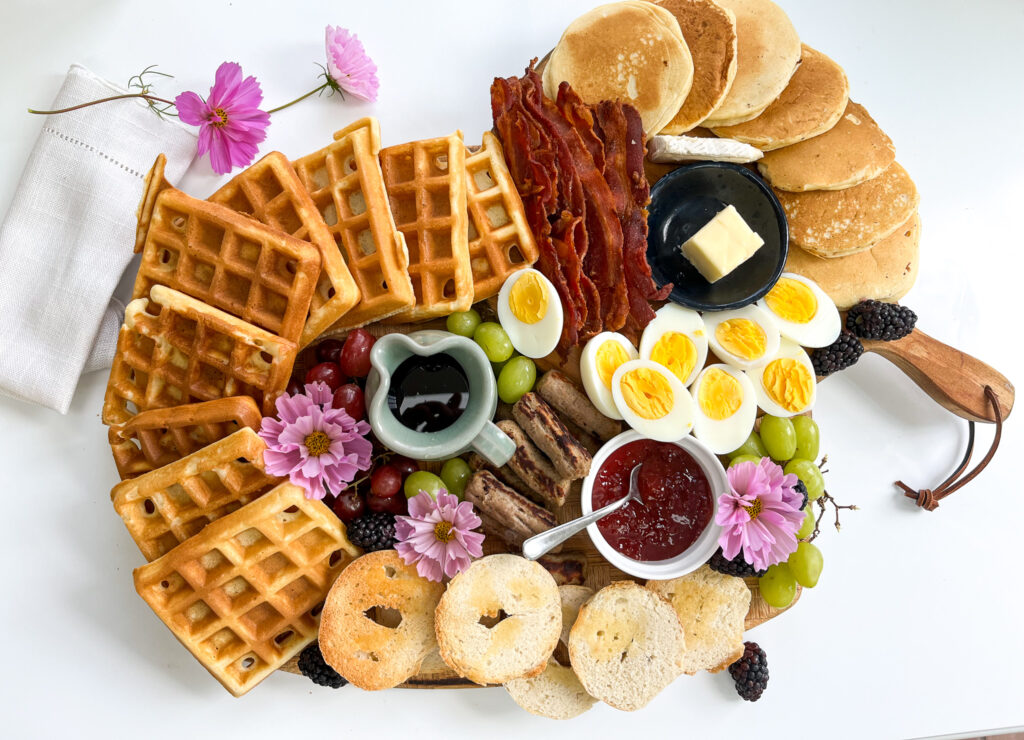
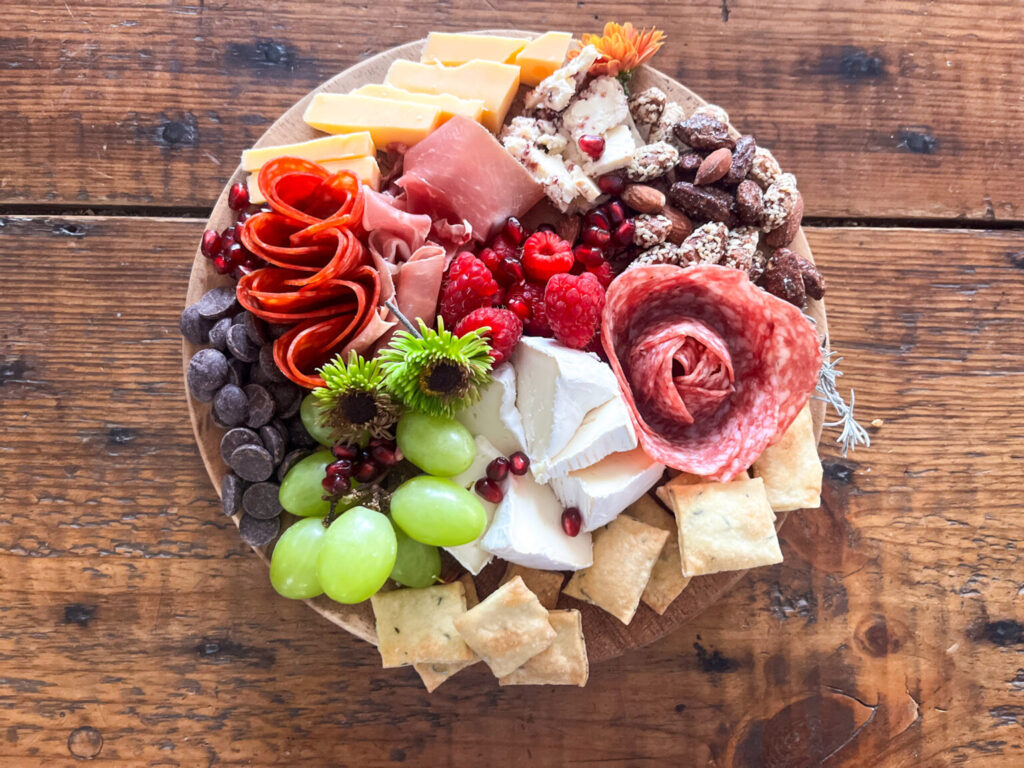
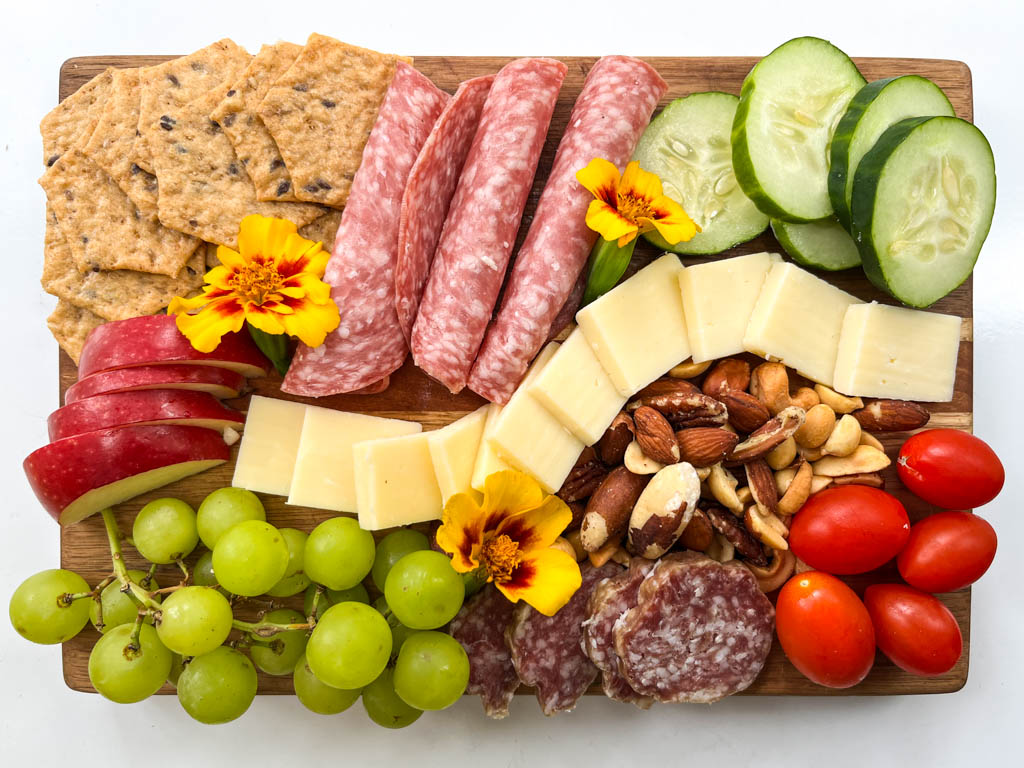
A charcuterie board is a curated platter of meats, cheeses, fruits, crackers, and other accompaniments, arranged on a single board or tray. It’s designed to be portable, easy to prep ahead, and sized for a smaller group — anywhere from a couple of people to a dinner party of 12–15.
Charcuterie boards are typically built using a simple ratio of ingredients, like my 3-3-3-3 Method, and can be assembled at home, wrapped, and transported to wherever you’re headed.
Good fit for:
- Date nights and small get-togethers
- Dinner parties
- Wine nights
- Family gatherings
- Any event where the food is one part of the evening, not the main event
What Is a Grazing Table?
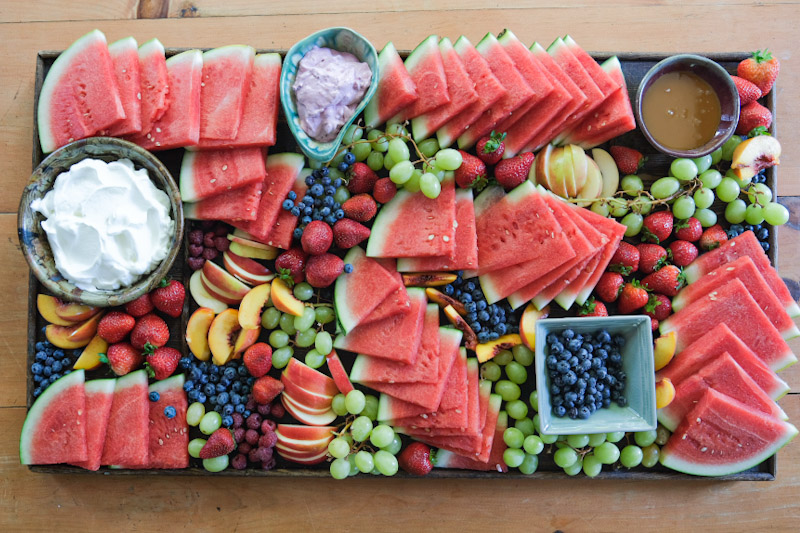
A grazing table takes the same idea, cured meats, cheeses, fruit, crackers, dips, and spreads it across a full table instead of a single board. Think of it as several charcuterie boards combined into one continuous, overflowing spread, often with multiple serving heights, bowls, and stations built directly into the display.
Grazing tables are usually the centerpiece of the event rather than a supporting appetizer. They’re built to be seen from across the room and to keep a large number of guests fed and grazing throughout the party — hence the name.
Good fit for:
- Weddings and cocktail hours
- Corporate events and conferences
- Milestone birthdays or anniversary parties
- Any event where the spread itself is part of the entertainment
Key Differences Beyond Size
Setup and Timeline
A charcuterie board can be prepped ahead and assembled in under 30 minutes. A grazing table is a different level of production, most are built directly on-site, often over the course of a few hours, since the ingredients need to be layered and styled across a much larger surface.
Cost
A charcuterie board can be built for as little as $20–$50 using my Budget Board Rule, while a full grazing table for a wedding or large event can run several hundred dollars up to $1,000 or more, depending on guest count and ingredients.
Who’s Serving Themselves
With a charcuterie board, guests are usually clustered around one table or coffee table. With a grazing table, guests move along the spread the way they would a buffet — which means you’ll want to think about flow, multiple entry points, and enough serving utensils spaced throughout so there’s no bottleneck.
Design Approach
Charcuterie boards rely on tight, intentional layout: every inch of the board is visible and considered. Grazing tables use height and repetition: stacked crates, cake stands, and cascading elements to create visual interest across a much bigger area, along with repeated “mini clusters” of ingredients so the whole table feels full rather than sparse in any one section.

Can You Turn a Charcuterie Board Into a Grazing Table?
Yes, and it’s actually one of the easiest ways to scale up if your guest list grows. Rather than building one giant table from scratch, group several smaller charcuterie boards together, each with a slightly different theme or ingredient focus, and let them collectively read as one larger spread. This is also a great option if you’re hosting and want help — check out my guide to hosting a charcuterie party where everyone brings a board, which naturally creates a grazing-table effect without any one person doing all the work.
Which One Should You Choose?
- Serving fewer than 15 people? Stick with a charcuterie board: it’s easier to prep, transport, and store leftovers of.
- Hosting a wedding, large party, or corporate event? A grazing table is worth the extra setup time: it becomes part of the decor.
- Not sure how many people are coming? Start with the Portion Calculator to see where your guest count actually lands — it may be smaller (or bigger) than you think.
Frequently Asked Questions
Is a grazing table the same as a charcuterie board? Not exactly — a charcuterie board is a single platter for a smaller group, while a grazing table is a much larger, table-sized spread designed to feed a crowd. The ingredients are similar; the scale and setup are different.
How many people does a grazing table serve? Most grazing tables are built for 20 or more guests, though the exact number depends on the length of the table and how many food stations you include.
Is a grazing table more expensive than a charcuterie board? Yes, generally. A charcuterie board can cost as little as $20–$50, while a full grazing table often runs several hundred dollars or more due to the volume of ingredients and setup time involved.
Can I make a grazing table at home without hiring someone? Absolutely. It takes more time than a standard board, but the same core techniques apply — just scaled up. Start with a layout plan, work in repeated clusters of ingredients, and build height with stands or crates.
Final Thoughts
Both a charcuterie board and a grazing table are built on the same idea: good food, arranged well, meant for sharing. The one you choose really just comes down to your guest count and how much of a centerpiece you want the food to be. Start small with a board, and you’ll have all the skills you need to scale up to a table when the occasion calls for it.
Want more ideas? Join my newsletter.